Writing a summary after attending two events where we tasted the difference water can make to coffee, leaves me with mixed feelings. If you are a coffee roaster, brewer or drinker you should know that water is important, by now.
For those that love events without latte art, marketing talk, or having to meet a coffee rock star this event was right up their street.
There are many assumptions around water in the coffee industry and several of them around the SCAA standard of TDS in a water. This measure is practically useless. To quote Maxwell Colonna-Dashwood in his many talks on coffee, waters with identical TDS will not make identical coffee. So what is the secret?
To make light work of the research and effort done in Water for coffee, the book co-authored by Maxwell Colonna-Dashwood and Christopher H. Hendon, would be a sin. So that is why the events were designed around measuring Carbonate Hardness (KH) and General Hardness (GH) only.
Although GH is also subject to error, since it includes other minerals, it is a guide of how much of the good stuff there is to make the tasty stuff in coffee (excuse the vagueness but in summarizing the work, vagueness is the best I can do).
KH is the measure of the buffer or bad stuff in the water, the stuff that prevents tasty stuff from becoming soluble.
So did the taste tests prove any of this?
Well, all the people tasting coffee preferred the coffees that were in the ideal zone as per the graph. And the closer the waters were in having good GH and KH values the better. At both events the distilled water performed the worse, which is good, since this means that everyone could taste the really bad water. Also at both events the water with the highest KH was also identified as second worst.
The interesting thing is that there was a certain taste acclimation for the people that cupped their coffees regularly on the filtered or standard water that most roasters were using in the area. Even though these coffees where not the best on the day, the general feeling was they were not that bad. This shows that the fear expressed in the book, and in some of the talks Chris and Maxwell have hosted, that roasters have local water acclimation and therefor roast to their water is true.
For those that did not make the event, I would suggest you cup your roasted coffee with bottled or spring water as well as your normal water to see how much your tastes buds have acclimated to your local water, and then make a decision on how and if you want to improve your coffee. Next learn about assessing water and fix it to be in the zone.
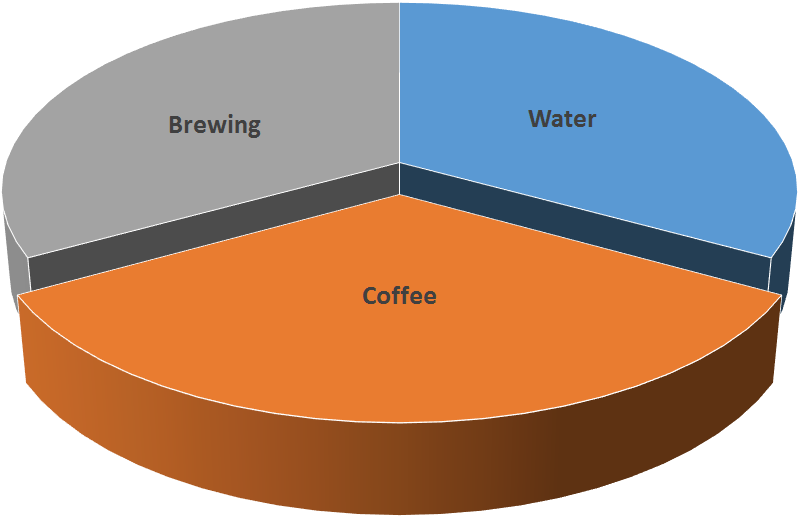
Personally these events were a real eye opener, we have a significant client base of home brewers and this information has forced me to re-evaluate my own methods in qualifying the coffees we roast, and how they are going to be consumed by other coffee lovers. As a coffee lover I would say a good coffee is a third water and third coffee and third brewing skill. Don’t asked me where I got those numbers since they are gut feel numbers rather than numbers backed by real science. And just to make sure it is true I put it in a graph so it has to be.
Thanks
Thanks to Cuth for setting up the Jozi event, you are a legend.
Thanks to Matt for organizing Tribeca to host.
Thanks to Philip from Run Rabbit Run in hosting and assisting so much with the CT event.
Opinions expressed in this summary are from Warren Machanik from Quaffee.
Leave a Reply